Why Your eCommerce Data Is Not Ready for AI Agents (2026)
Quick summary: Shopify #1001, OMS SO-1001, WMS PICK-88 — three ids, one paid order. Document one join this week. The ~$791/mo platform cost floor at 50,000 sessions buys nothing if the join is a guess.
Key Takeaways
- Shopify #1001, OMS SO-1001, WMS PICK-88 — three ids, one paid order
- The ~$791/mo platform cost floor at 50,000 sessions buys nothing if the join is a guess
- This is series part 45: orders, customers, products, inventory, returns, support, and marketing as one business data layer
- It is not a remake of the SKU contract — that is AI-ready product catalog (part 35)
- It is not PIM extract → validate → merchandiser publish — that is catalog management (part 9)

Table of Contents
Monday, the associate opens a ticket for order #1001. Shopify says paid. The warehouse says PICK-88. The OMS says SO-1001. Nobody can name which id the shopper should hear.
This is series part 45: orders, customers, products, inventory, returns, support, and marketing as one business data layer. It is not a remake of the SKU contract — that is AI-ready product catalog (part 35). It is not PIM extract → validate → merchandiser publish — that is catalog management (part 9). We do not invent a client completeness score. After July 30, 2026, new agents should not start on the older Agents Classic product.
The job. Make commerce facts joinable: canonical ids, documented joins, freshness (asOf), and named read tools. Not a warehouse chatbot. Not unrestricted SQL.
This week. Document one join for one workflow — usually where-is-my-order. Stamp asOf on inventory and price. Name three read tools. No SQL tool.
A person still signs. Refunds, stock changes, customer merges, and anything that writes a live price.
Skip it when the only “API” is a BI export, or when Shopify / OMS / WMS ids still disagree and nobody owns the map.
Our take: do not start with AWS. Document one join key before you host a loop. Trade-off: the board deck waits a sprint. You stop paying session cost for an agent that cannot tell Shopify #1001 from OMS SO-1001 from WMS PICK-88.
Copy the join map — Open
ai-ready-business-data-layer.md. Mark your join keys and the first workflow that would fail without them. Do not submit the demo domain table as a completeness score. Series folder:ecommerce-ai-agents-series/.
FactualMinds is an AWS Select Tier Services Partner. We help merchants sequence the data layer and the agent — we do not sell a lakehouse as a chatbot.
What “AI-ready” means on the floor
An AI-ready business data layer is a contract: canonical ids, documented joins, freshness (asOf), and named tools that return those fields. It is not “we have Shopify plus a replica.”
| Domain | Agent needs | Typical break |
|---|---|---|
| Orders | Canonical order id, status, lines, tokenized payments, asOf | Shopify id ≠ OMS id ≠ WMS id |
| Customers | Stable customer_id, not email-as-key | Duplicate customers; guest vs account |
| Products | Parent/child, GTIN, required attrs | That slice is post 35 |
| Inventory | Available-to-promise on the sellable SKU | Nightly dump; location vs online mismatch |
| Returns | RMA id, reason, refund state, prior RMAs | Return not joined to original line |
| Support | Ticket id, order ref, policy version | Tickets without order id |
| Marketing | Campaign id, spend, attributed orders | Ads in a CSV; no join to SKU |
Where-is-my-order breaks when the helpdesk ticket cannot load OMS status. Returns eligibility breaks when the RMA cannot see the original line. Root cause invents “ads” when campaign ids never landed on the order. A perfect product page does not join a guest checkout to a loyalty account.
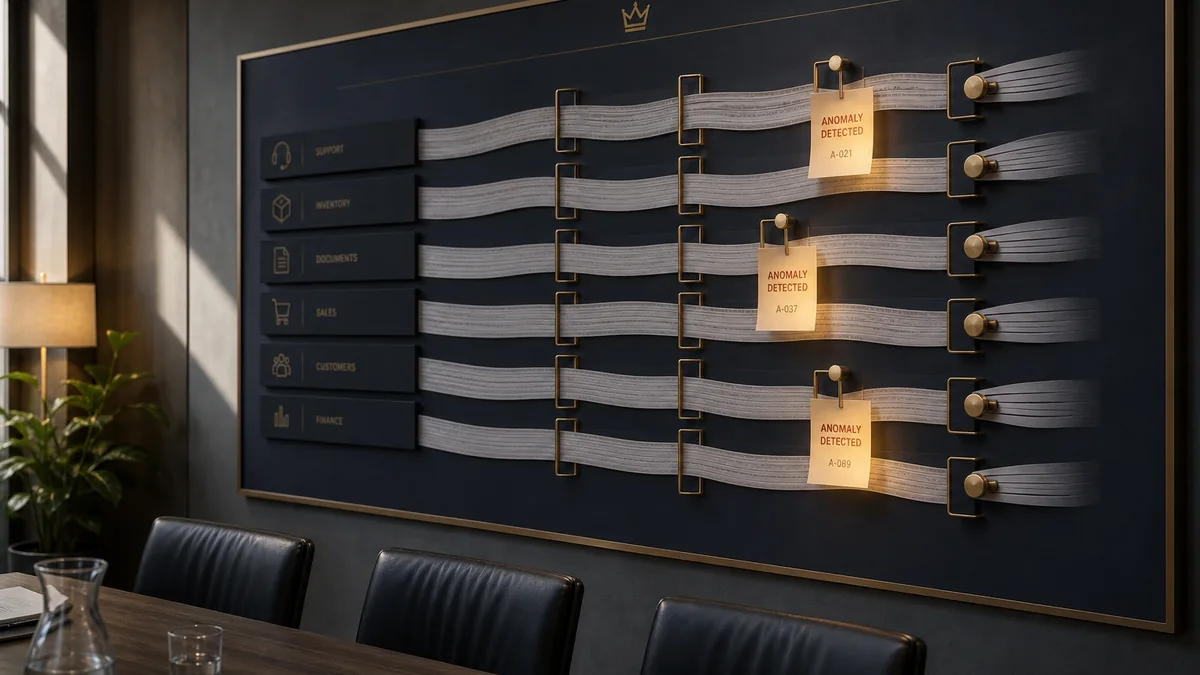
Three ids become one map
flowchart LR
  storefront[Storefront IDs]
  oms[OMS IDs]
  wms[WMS IDs]
  helpdesk[Helpdesk IDs]
  ads[Ad platform IDs]
  frag[Fragmented identities]
  layer[AI-ready business data layer]
  tools[Named read tools]
  agents[Agents]
  storefront --> frag
  oms --> frag
  wms --> frag
  helpdesk --> frag
  ads --> frag
  frag --> layer
  layer --> tools
  tools --> agents
The layer is the join map plus freshness plus personal-data policy. Tools are how agents are allowed to read it. Agents never SELECT *. Downstream posts in this cluster:
- Data agent (part 46) — cross-entity evidence, still no SQL
- Data quality monitoring (part 47) — deterministic detect, optional investigate
- Root cause (part 48) — hops with a human on the narrative
If you skip the layer, those three posts become prompt engineering on a lie.
Common breaks (checklist you fill)
From the artifact. Counts are yours. Demo rows in the markdown are fixtures.
- Different IDs across storefront / OMS / WMS / helpdesk
- Missing fields the first workflow requires (where-is-my-order needs status + carrier scan, not a 200-column order export)
- Duplicate customers (email + phone + guest)
- Incomplete products (required attrs empty) — fix via post 9 / post 35, do not redefine the SKU JSON here
- Disconnected systems (no API, only Admin UI)
- Delayed data (no
asOf; cache older than the SLA you would defend to a shopper)
A lakehouse that lands all seven domains without join documentation is still fragmented. The agent will pick the id that appeared first in the tool JSON.
Support tickets without order_id are how where-is-my-order becomes a language model over a helpdesk dump. Marketing without campaign_id on the order is how root cause blames ads. Returns without original line ids are how refunds double-pay.
Minimum for a first agent
Pick one workflow. Default: where-is-my-order reads, not inventory writes.
- Join key documented (example:
shopify_order_id→oms_order_id). - Named read tools — not
executeQuery. Catalog for the evidence agent lives in part 46. asOfon inventory and price. If older than SLA, consumers seeunknown, notin_stock.- Personal-data columns not in the tool response unless the signed-in role allows it.
That is enough to host a loop. It is not enough to Fully Automate refunds. Autonomy stays a later table — spectrum.
# ai-ready-business-data-layer.md — minimum for workflow #1
JOIN shopify_order_id -> oms_order_id -> wms_shipment_id
JOIN customer_id stable; never email-as-key
ATP and price MUST carry asOf
TOOLS are named reads; no SELECT *
PII stripped unless JWT role allows
Do not start with AWS
Procurement wants a stack slide. The honest order is business contract → tools → host.
| Piece | Job here | Not its job |
|---|---|---|
Join map + asOf | Makes commerce facts addressable | A chatbot |
| Named tools | What the model is allowed to see | Warehouse dump |
| Bedrock | Models (Converse) + Guardrails | Agent host or data layer |
| Harness | CreateHarness / InvokeHarness on Runtime (GA June 17, 2026) | Shopify connector |
| Gateway + Cedar | Tool choke point; LOG_ONLY → ENFORCE | Prompt-as-authZ |
| Strands 1.0 | Agents-as-Tools, Graph, Swarm, Workflow after export | MicroVMs, Gateway, Identity, Policy, secrets |
| Next.js | Approval / ops UI | Runtime / sandbox |
| Agents Classic | Wrong net-new path after July 30, 2026 | “Just this once” |
There is no native Shopify AgentCore connector. Admin GraphQL, OMS, WMS, helpdesk, and ad APIs sit behind your OpenAPI or MCP. Size sessions on the calculator after you know which tools exist.
For your technical lead
On June 17, 2026, Amazon Bedrock AgentCore Harness reached general availability — a config-driven loop on the same platform as Runtime, Memory, Gateway, Identity, and Policy (What’s New). Agents Classic is in maintenance for new customers after July 30, 2026. A new commerce agent should not start on Classic InvokeAgent. Full matrix: lifecycle roundup.
First-party signals we reuse (not store results) — Gateway server-side tools cut median tool round-trip ~180 ms → ~95 ms on a B2B CRM assistant (12 tools, ~8k turns/day) — Gateway post. Platform cost silhouette: support-style AgentCore at 50K sessions/mo ~$791/mo platform plus model (decision guide. Price your mix on the AgentCore pricing calculator. Treat ~$791/mo as a platform cost floor to plan against, not as savings. Gateway ~95 ms is tool RTT on that CRM canary — not OMS p95, not storefront conversion.
What broke — A week-one Harness with
askWarehousethat accepted a free-text question and ran SQL on a replica. Three order ids for one checkout came back in different columns; the model concatenated them into a tracking sentence. Detection: a golden where-is-my-order turn cited a WMS pick id as the customer-facing order number; helpdesk paste included an email fromSELECT *. Fix: deleteaskWarehouse; documentshopify_order_id→oms_order_id; exposegetOrderonly; strip personal data in the tool. Lesson: a replica is not an AI-ready eCommerce data layer. Unrestricted SQL is how you skip the contract and still look “connected.”
A second failure: calling the stack AI-ready because the catalog passed post 35 while guest checkouts still had no customer_id and marketing lived in a weekly CSV. Search agents improved; where-is-my-order and root cause did not.
What to do this week
- Clone
ai-ready-business-data-layer.md. Fill the seven-domain table with your system names. - Pick one workflow (where-is-my-order unless you have a better volume case). List the fields it must read.
- Write the join: storefront order id → OMS → WMS. If you cannot, you do not have a layer.
- Stamp
asOfon inventory and price consumers. Fail closed tounknownwhen stale. - Name three read tools. No SQL tool. Browser off.
- Do not host a loop until step 3 exists. Then Harness GA June 17, 2026; not Classic after July 30, 2026.
- Next posts: data agent, quality monitors, root cause. Catalog slice only if SKUs fail: post 9, post 35.
- Model remaining sessions on the AgentCore pricing calculator. Book a conversation — contact us. Bring the join map, not a promised insight lift.
What this post doesn’t cover
- The SKU / offer contract for search, recommendations, and shopping agents — post 35
- PIM extract, deterministic publish gates, merchandiser approval — post 9
- Cross-entity tool catalog and evidence fields — part 46
- Monitor rules vs investigation — part 47
- Revenue-decline hop playbook — part 48
- A FactualMinds client ”% of orders joined” KPI — we are not inventing one
- Lakehouse vendor selection, CDC tooling, or dbt project layout
- Payment-card data in the layer (keep card numbers out of tools)
FAQ
When should we NOT call eCommerce data AI-ready?
Skip the label when Shopify order ids, OMS ids, and WMS ids still disagree; when inventory available-to-promise is a nightly dump without an asOf stamp; when guest and account records duplicate the same shopper; or when the only “API” is a BI export. Pretty dashboards are not a data layer. Agents will treat a guessed join as a fact.
What could go wrong if we start with AgentCore before the data layer exists?
The host will call three tools and get three identities for one order. Where-is-my-order, returns, and root-cause work all invent causality. You will spend the about $791 a month platform floor at 50,000 sessions on a demo that cannot name a single canonical order id. Join keys first; host second.
How is this different from the AI-ready product catalog (post 35)?
Post 35 is the SKU contract search, recommendations, and shopping agents consume — parent/child, GTIN, required attributes, checkout-true offer. This post is the business data layer: orders, customers, products, inventory, returns, support, marketing. Do not remake the catalog JSON here. If SKUs fail the contract, go to post 35 and post 9; if orders cannot join customers, stay here.
What could go wrong if marketing spend lives in a CSV with no campaign id?
Root-cause hops will blame “ads” with no evidence tool. The data agent cannot list attributed orders. Quality monitors cannot flag spend without a join. Keep campaign_id on the order or return unknown. Do not let the model fill the gap with a channel story.
Do we need a lakehouse before the first agent?
No. Pick one workflow (usually where-is-my-order). Document one join (shopify_order_id → oms_order_id), expose named read tools, stamp asOf on inventory and price, strip personal data unless the signed-in role allows it. A warehouse chatbot is the anti-pattern. Unrestricted SQL is not a layer.
Is Amazon Bedrock the data layer?
No. Bedrock is models (Converse plus Guardrails). Harness (GA June 17, 2026) is CreateHarness / InvokeHarness on Runtime. Gateway plus Cedar is the tool choke point. Strands 1.0 is Agents-as-Tools / Graph / Swarm / Workflow after export — not infrastructure. Next.js is the approval UI, not the runtime. There is no native Shopify AgentCore connector. Do not start with AWS; start with join keys.
Need an AI-ready eCommerce data layer before the first loop, not a SQL chatbot on a replica? Contact FactualMinds or start from Generative AI on AWS and AWS for retail / eCommerce.
AWS Cloud Architect & AI Expert
AWS-certified cloud architect and AI expert with deep expertise in cloud migrations, cost optimization, and generative AI on AWS.